
I’ve noticed something over 26 years of treating skin in Sydney. The clients who come in during June and July almost never regret it. The ones who wait until October, hoping to get “summer ready” in a few weeks, almost always wish they had started sooner.
It’s not because my winter clients are more patient or more disciplined. It’s because they happened to book at the one time of year when a non-surgical facelift actually works the way it’s supposed to.
Most people assume the best time to fix loose or tired-looking skin is right before the event that’s making them self-conscious about it, a wedding, a reunion, summer itself. I see the opposite pattern play out in my clinic every year. The treatment that produces a real, lasting lift needs months to do its job, and Sydney’s cooler season happens to give it exactly the conditions it needs.
When clients ask me about a “non-surgical facelift,” they’re usually picturing something immediate, like a filler or a quick tightening session. That’s not how HIFU or radiofrequency treatment works, and I’m upfront about that from the first consultation.
HIFU (High-Intensity Focused Ultrasound) sends focused energy beneath the surface of the skin to stimulate your own collagen and elastin. Radiofrequency does something similar using controlled heat, which I find particularly effective on a sagging jawline or loose skin under the chin. Both work by convincing your skin to rebuild itself from the inside. That process takes weeks to show, and months to finish.
I tell clients often: we’re not doing the lifting. Your own skin is doing the lifting. We’re just giving it a reason to.
That distinction is the whole reason timing matters so much.
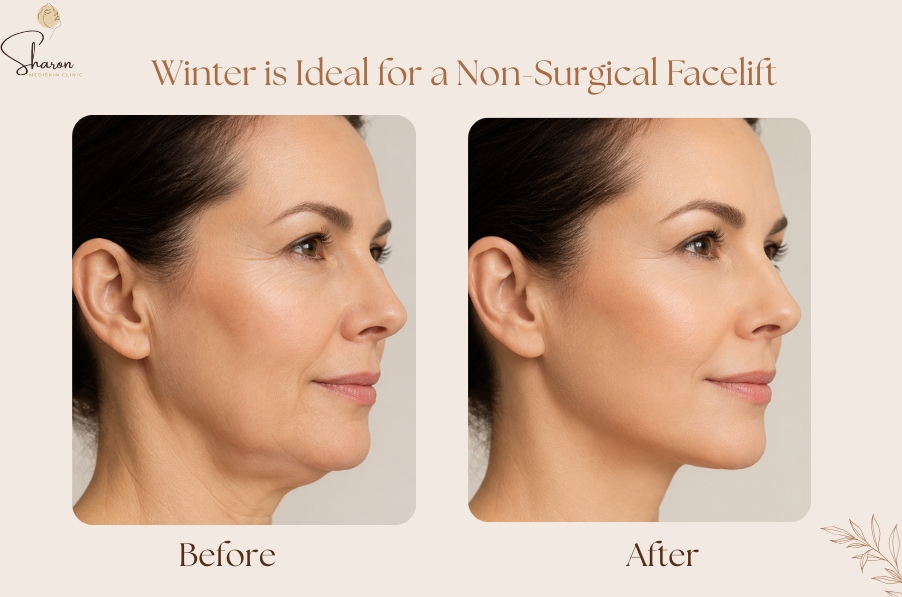
Here’s the part most clinics won’t explain properly. After a HIFU or RF session, your skin is in an active repair phase, which makes it considerably more reactive to UV exposure than usual. In Sydney, even a mild summer morning carries enough UV to interfere with that healing window and risk pigmentation in some clients, particularly anyone with a tendency toward melasma or sun spots.
Winter changes that equation. Sydney’s UV index drops low enough that the skin can go through its repair cycle with far less interference. Collagen rebuilds more predictably. There’s less risk of the kind of post-treatment pigmentation that can undo the very results you came in for.
There’s a second reason that has nothing to do with biology and everything to do with the calendar. Spring and summer in Sydney are packed: Christmas, New Year’s, school holidays, a steady run of weekends booked out. Winter clears that noise. My clients who start in winter tend to actually show up for every follow-up, which matters more than people expect, because a facelift built from a handful of consistent sessions looks completely different from one built from a rushed, interrupted schedule.
By the time September arrives, a client who started in June isn’t hoping for a quick fix. She’s already several months into a process that’s finishing exactly when she wants to look her best.
A common scenario in my Castlecrag clinic: a woman in her early forties comes in noticing her jawline has softened and her neck doesn’t snap back the way it used to. She’s not interested in surgery, and she’s not interested in anything that requires a week of hiding indoors.
I start with an honest look at what’s actually happening in the skin, not a sales pitch. Some clients need HIFU alone. Others need RF layered in for the neck and jowls specifically. A few need both, spaced out over several months rather than crammed into a few weeks. There’s no standard package, because there’s no standard face.
A typical session with me runs between 45 minutes and 90 minutes, depending on what we’re treating; commonly the lower face, jawline, neck, brow, and décolletage. There’s no downtime. Clients walk out and go back to work, which is part of why I see so many people book a session on a lunch break.
This isn’t a treatment aimed at one type of client. I see:
Winter in Sydney does not last long. The clients who get the best results are not the ones who do the most sessions. They are the ones who start at the right time and let the process actually finish before summer arrives.
If you’ve been putting it off, this is the conversation to have now, not in October.
Call my clinic in Castlecrag to book a consultation.

Sharon is a highly experienced cosmetic practitioner with over 26 years of clinical experience in advanced skin and laser treatments in Sydney. Her expertise includes acne peel treatment, pigmentation laser treatment, skin rejuvenation treatment, skin care laser treatment and non-surgical skin tightening.
Sharon’s philosophy is simple: treat the cause, protect the skin barrier, stimulate natural collagen and create long-term healthy skin, not temporary improvements.