
If you have been researching non-surgical skin tightening in Sydney, you have almost certainly come across two names more than any others: HIFU and radiofrequency. Both are energy-based treatments. Both stimulate collagen. Both promise to lift and firm without surgery or downtime. And both are offered at clinics across Sydney, often side by side on the same treatment menu.
So how do you know which one is right for your skin?
The honest answer is that it depends on what you are trying to achieve, the current condition of your skin, and where you are in your skin tightening journey. At Sharon MediSkin Clinic at Castlereagh, we treat clients with both technologies regularly, and we tailor the choice to the individual rather than applying a blanket protocol. In this post, we want to give you a genuinely useful, jargon-free breakdown of how each treatment works, what each one is best suited to, and how to make a confident decision before you book.
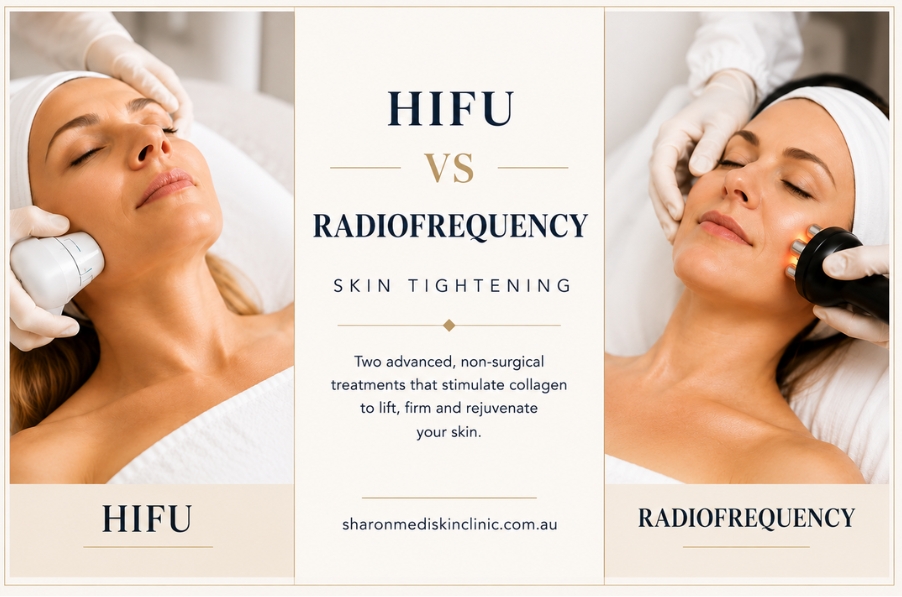
HIFU stands for High-Intensity Focused Ultrasound. It is a technology that uses focused ultrasound energy to reach deeper into the skin than most other non-invasive treatments can.
To understand why that matters, it helps to know a little about the skin’s structure. The outermost layer is the epidermis. Beneath that sits the dermis, where collagen and elastin fibres live. And beneath the dermis, in the deeper tissue layers, sits the SMAS layer, which stands for Superficial Musculoaponeurotic System. This is the same layer that surgeons target during a traditional facelift.
HIFU is the only non-invasive treatment that can reach and stimulate the SMAS layer. It does this by delivering precise, focused ultrasound energy to a specific depth beneath the skin’s surface, creating controlled thermal injury points at that depth. These micro-injuries trigger the body’s natural healing response, which produces new collagen and causes the tissue to gradually contract and lift.
The treatment itself takes between 60 and 90 minutes depending on the areas treated. Most clients feel a warm, prickling sensation during the procedure, particularly over bony areas, but it is well tolerated and requires no anaesthesia. There is minimal redness or swelling immediately after, which usually settles within a few hours.
The results from HIFU develop gradually over eight to twelve weeks as new collagen forms, with the full lifting effect visible at around the three to six month mark. Results typically last between 12 and 18 months depending on your skin condition, age, and aftercare.
Radiofrequency, often referred to as RF, works differently to HIFU in how it delivers energy but shares a similar end goal: stimulating collagen production to firm and tighten the skin.
RF technology passes an electrical current through the skin tissue, generating heat at a controlled depth within the dermis. This heat causes two things to happen. First, existing collagen fibres contract immediately, producing a visible tightening effect in the days following treatment. Second, the thermal response triggers the body to produce new collagen and elastin over the following weeks, improving the skin’s structural quality and firmness over time.
Because RF energy heats a broader area of the dermis rather than targeting a single focal depth the way HIFU does, it tends to produce a more gradual, diffuse tightening effect. This makes it particularly well suited to improving overall skin texture and firmness across larger areas such as the cheeks, neck, jawline, and abdomen.
RF treatments are generally very comfortable. Most clients describe a warming sensation similar to a hot stone massage. There is no downtime and the skin typically looks calm and slightly flushed immediately after, which settles quickly.
Results from RF skin tightening tend to be visible sooner than with HIFU, often within two to four weeks, though the initial effect is subtler. A course of treatments, typically four to six sessions spaced two to four weeks apart, produces the most significant and lasting improvement.
Here is a straightforward comparison of how the two treatments differ in practice:
Rather than telling you that one treatment is universally better than the other, we think the more useful approach is to match the technology to your concern.
At Sharon MediSkin Clinic, we frequently use HIFU and RF in combination, either in the same session or as part of a structured treatment plan. This combined approach allows us to address both the deeper structural tissues with HIFU and the surface dermal quality with RF, producing a more comprehensive result than either treatment achieves alone.
Both HIFU and RF can be applied to body areas as well as the face and neck. RF in particular is widely used for skin tightening on the abdomen, inner arms, inner thighs, and around the knees. These are areas where skin laxity is common following weight loss or as a natural part of ageing, and where surgical options carry significant risk and recovery time.
If body skin tightening is a concern alongside facial treatments, this is something our team will discuss with you during your consultation. We will assess the area, consider the most appropriate technology, and set realistic expectations about what non-invasive treatment can achieve for your specific situation.
Yes, and there are practical reasons for this beyond the seasonal marketing message you will often see from clinics.
Both HIFU and RF create a controlled thermal response in the skin, and in the weeks following treatment your skin is in an active repair and renewal phase. During this time, UV exposure can interfere with healing and, in some skin types, trigger unwanted pigmentation. Sydney’s winter UV index is significantly lower than in spring and summer, which means your skin can heal more predictably and the results of your treatment are better protected.
Beginning a skin tightening treatment course in June or July also means arriving at the warmer months with the full benefit of collagen remodelling behind you. Results from HIFU, in particular, continue developing for up to six months. Starting now means looking your best when the social season picks up again in spring.
If you are still unsure whether HIFU or radiofrequency is the right treatment for your skin, the best next step is a consultation rather than a guess. Sharon Kim will assess your skin in person, listen to your concerns, and give you an honest recommendation based on what will actually make a meaningful difference for your specific situation.
We do not believe in overselling treatments or recommending procedures that are not appropriate for your skin. Our goal is to help you achieve real, lasting results through the most suitable path.
Call Sharon MediSkin Clinic today to book your non-surgical skin tightening consultation in Sydney. Our Castlereagh clinic is welcoming new clients now.