
Acne is something most people deal with at some point in their lives. But for many, the breakouts themselves are only part of the story. What gets left behind, the dark marks, the uneven texture, the shallow depressions in the skin, can linger for months or even years after the acne itself has cleared. And no matter how carefully you follow a skincare routine, some of that damage simply will not shift without professional help.
If you have been living with acne scarring and wondering whether anything can actually be done about it, the answer is yes. The treatments available at a professional clinic level today are a long way ahead of where they were even five years ago. At Sharon MediSkin Clinic, Sydney, we see clients regularly who have spent years trying to address acne scarring on their own before finally booking a consultation and discovering what is genuinely possible.
This post is for anyone at that point. We want to explain the different types of acne scarring, the treatments that work for each one, and why right now in winter is the best time to start.
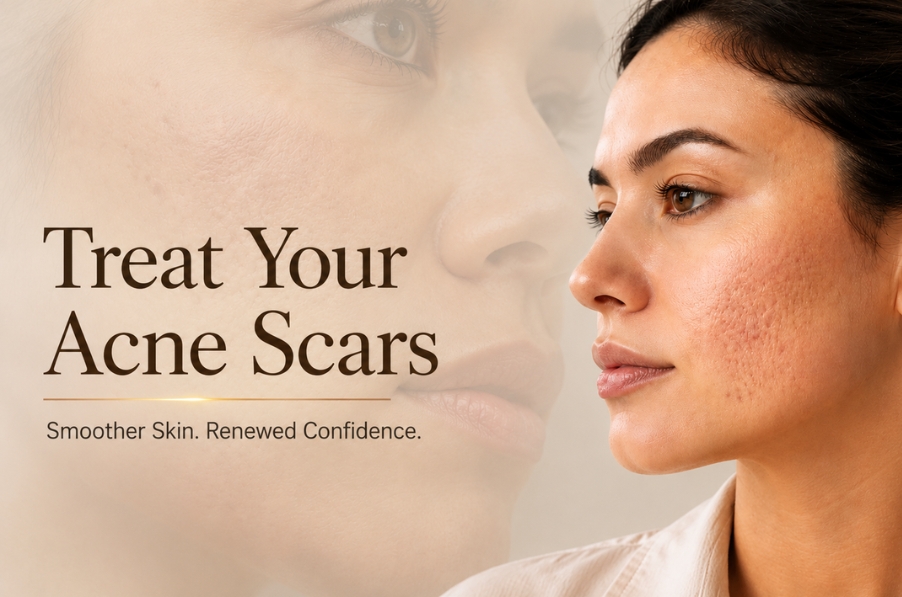
Before diving into treatment options, it is worth understanding that acne scarring covers several quite different skin concerns, and each type responds to different treatments. Using the wrong approach for your specific type of scarring is one of the main reasons people feel like nothing is working.
Understanding which type, or combination of types, you are dealing with is the first step toward choosing the right treatment. This is exactly what a professional skin assessment at Sharon MediSkin Clinic will help you determine.
Chemical peels are one of the most effective and accessible starting points for acne scarring, particularly for clients dealing with PIH, PIE, and mild textural irregularity. A clinical-grade peel works by accelerating the skin’s natural exfoliation process, removing the outermost layer of dead skin cells and stimulating healthy cell turnover beneath.
Different peel formulations target different concerns. Glycolic acid peels are particularly effective for PIH and overall skin brightening. Salicylic acid peels work well for oily, acne-prone skin types where congestion and active breakouts are still a concern alongside existing scarring. Lactic acid peels are a gentler option for more sensitive skin.
At Sharon MediSkin Clinic, peel treatments are always selected based on your skin type, concern and tolerance. A course of peels, typically four to six treatments spaced two to four weeks apart, produces a visible improvement in skin tone, clarity, and texture that builds with each session.
For clients dealing with persistent dark marks, particularly deep PIH or long-standing post acne pigmentation, laser treatment is often the most effective option when peels alone are not achieving sufficient clearance.
Laser treatment for post-acne pigmentation works on the same principle as pigmentation treatment for sunspots. The laser energy is selectively absorbed by the melanin in the dark marks, breaking down the pigmented cells so they can be naturally cleared by the body. The result is a progressive fading of marks over the weeks following treatment.
For clients whose post-acne marks have not responded adequately to topical skincare or peels, laser treatment often produces results that feel genuinely transformative. Combining laser treatment with a course of skin peels can also address both the pigmentation and the surface texture concerns simultaneously.
For clients dealing with atrophic scarring such as rolling scars, boxcar scars, and shallow icepick scars, skin needling is one of the most clinically supported treatments available. Fine needles create precise, controlled micro-channels in the skin, triggering a wound-healing response that stimulates the production of new collagen and elastin.
Over a course of treatments, this new collagen gradually fills in the depressed scar tissue, improving the skin’s surface texture and reducing the visibility of scarring. Skin needling is suitable for all skin tones and does not carry the pigmentation risks associated with some laser technologies in darker skin types.
For many clients with acne scarring, the most effective approach combines more than one treatment modality. A course of peels to address PIH and surface congestion, combined with skin needling to target atrophic scarring, and laser treatment for any deep or stubborn pigmentation can produce a far more comprehensive result than any single treatment alone.
At Sharon MediSkin Clinic, Sharon Kim will assess your scarring in full during your consultation and recommend a plan that addresses each of your specific concerns in the most logical and effective sequence. We never recommend treatments you do not need, and we will always give you an honest assessment of what is realistically achievable.
We want to acknowledge something that does not get said often enough in clinical settings. Living with acne scarring is not just a cosmetic concern. For many people, it has a genuine impact on confidence, the way they feel in social situations, and how they see themselves day to day.
People who have cleared their acne after years of struggling often expect their skin to simply reset. When the marks and texture remain, it can feel defeating. Clients sometimes come to us having spent significant money on products that promised results but delivered very little, or having tried treatments elsewhere that were not well matched to their specific type of scarring.
We hear this often. And we want to be straightforward with you: not every treatment works for every type of scarring, and real improvement takes consistency over time. But with the right treatment protocol and realistic expectations, meaningful change is absolutely achievable. We have seen it hundreds of times.
If you have been putting off booking an acne scar consultation, winter is the time to act. Here is why.
Most of the treatments that produce the most significant improvement for acne scarring, including peels, laser treatment, and skin needling, involve some degree of skin renewal and repair in the days or weeks following each session. During this recovery phase, your skin is more sensitive to UV radiation than usual. Sun exposure during this time can trigger new pigmentation, slow healing, and in some cases worsen the very marks you are trying to treat.
Sydney’s winter UV index is considerably lower than in spring and summer, giving your skin a much safer environment to heal and respond to treatment. Beginning a treatment course in July means completing the most intensive phase of your protocol before UV levels climb again in September and October.
It also means arriving at spring and summer, when social events pick up and lighter clothing comes back out, with skin that has been genuinely improving for months rather than still being in the early stages of treatment.
When you come in to see us at Sharon MediSkin Clinic, your first consultation is focused entirely on understanding your skin and your concerns before any treatment is recommended.
Sharon will take the time to look closely at your scarring, identify the types you are dealing with, review your skin history and any previous treatments you have tried, and ask about your lifestyle and sun exposure habits. From there, she will build a treatment plan that addresses your concerns in a logical order, with clear expectations at each stage.
We will always be upfront about what we can realistically achieve and how long it is likely to take. Acne scar treatment is not an overnight fix, but with the right plan in place the progress you will see over a three to six month period can be significant.
If acne scarring has been affecting your confidence and you have been wondering whether professional treatment is worth exploring, the answer is to book a consultation and find out exactly where you stand.
At Sharon MediSkin Clinic at Castlereagh, we bring over 26 years of experience in cosmetic and aesthetic medicine to every client we see. We will give you an honest assessment, a personalised treatment plan, and a clear picture of what is possible for your skin.
Call us today to book your acne scar consultation in Sydney. Winter is the best time to start, and the sooner you begin, the sooner you will see real progress.