
Skin does not age in a straight line. It tends to hold fairly steady for years and then shift, sometimes quite noticeably, in a relatively short period. The shift that happens in your mid-30s feels different from the one in your mid-40s, which feels different again from what changes in your 50s. And most people, when they notice something has changed, have no real frame of reference for whether it is normal, early, late, or something they should be doing something about.
This post is about giving you that frame of reference. What to expect at each stage, why it happens, and what kinds of professional treatment make the most sense at each point. We work with clients across all three of these decades every week at Sharon MediSkin Clinic, and the questions each group asks are genuinely different because the skin concerns at each stage are genuinely different.
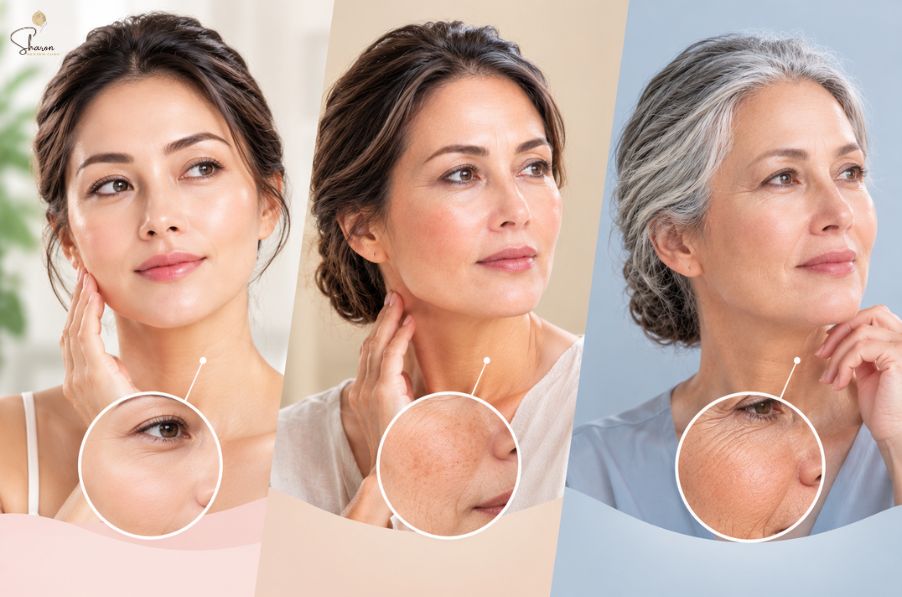
Your 30s are when the biology of skin ageing begins in earnest, even though the visible results are usually still fairly subtle for most of the decade. Collagen production starts to decline from around the mid-20s, but by the time you are in your 30s that decline is accumulating into something you can actually see and feel.
The most common things people notice in their 30s are fine lines appearing around the eyes and forehead for the first time, skin that takes a little longer to recover from a late night than it used to, and a general feeling that the skin does not quite have the effortless quality it had at 25. It is not dramatic. But it is noticeable to the person in the mirror.
Sun damage also starts showing up more visibly in the 30s. The pigmentation that accumulated across your 20s from Sydney summers, beach days, and outdoor sport starts coming to the surface. Freckles deepen. Patches of uneven tone appear. Clients in their 30s are often surprised by how much their skin tone has changed from how it looked a decade earlier.
What tends to help most in this decade is a combination of good professional prevention and targeted correction. A course of skin peels or a well-designed Korean facial treatment protocol builds the skin’s structural quality and addresses early pigmentation before it becomes more established. The clients who invest in their skin in their 30s consistently find they are dealing with far less in their 40s.
If you take nothing else from this section: start wearing SPF 50 every day right now if you are not already. In Sydney’s UV environment, it is the single most effective anti-ageing investment available.
The 40s are when skin ageing shifts from something you notice occasionally to something that requires a more deliberate response. The changes in this decade tend to be more structural than surface-level, which is why the skincare products that worked in your 30s may start feeling insufficient.
Collagen and elastin loss accelerates through the 40s, and the effects become visible as laxity. The jawline softens. There is a heaviness that develops in the midface and cheeks. The skin along the neck starts to sit differently. Fine lines become more established, and new ones appear in areas that were unaffected before. The overall facial contour begins to change in ways that feel more meaningful than the surface-level texture concerns of the previous decade.
Hormonal changes through the perimenopause years, which for many women begin during their 40s, compound these structural changes. Oestrogen supports collagen production, and as levels fluctuate and decline, the skin loses structural support faster than it would through age alone. Pigmentation can also become more unpredictable and harder to manage in this period.
This is the decade where energy-based treatments like HIFU and radiofrequency skin tightening start making a real, visible difference. These technologies work at the depth where the structural changes are happening, stimulating collagen and lifting tissue in a way that surface treatments simply cannot. Clients in their 40s who incorporate HIFU or RF into a regular treatment schedule consistently find they are managing the pace of change effectively rather than feeling like they are trying to reverse something that has run ahead of them.
It is also the decade where the combination of treatments matters most. A Korean facial treatment for skin quality and hydration, a course of peels for pigmentation management, and targeted skin tightening for structural concerns, used in a sensible, well-timed sequence, produces a cumulative result that feels genuinely meaningful. This is the kind of personalised treatment plan Sharon puts together for clients in their 40s regularly, and it works because it is addressing the actual picture of the skin rather than a single concern in isolation.
There is a particular assumption that floats around about skin in the 50s: that the window for doing anything meaningful has passed, that this is the stage where you accept what is there and move on. That assumption is wrong, and we want to be direct about that.
Skin in the 50s responds to treatment. It does not respond as quickly as skin in the 30s, and it requires a more considered approach, but the improvements achievable with the right protocol are real and often genuinely surprising to clients who had resigned themselves to a certain appearance.
The primary changes in this decade are continued and accelerating collagen loss, significant skin laxity in the face and neck, deepening of established lines, continued pigmentation and sun damage, and for many women, the more pronounced effects of post-menopausal hormonal shifts on skin structure and moisture retention. Skin in the 50s is typically drier and more fragile than in previous decades, which means treatment protocols need to be more careful and gradual.
What works well in this decade is a combination of deep structural lifting through HIFU, ongoing skin quality support through Korean facial treatments and appropriate peels, and consistent at-home care using products that genuinely nourish and protect the skin barrier. For clients dealing with significant pigmentation from decades of Sydney sun exposure, laser treatment can produce improvements that feel transformative even when the underlying skin has aged considerably.
The honest message for clients in their 50s is this: you are not too late. You have more options than you have probably been told, and the right starting point is simply a proper skin assessment to understand what you are working with. The conversation Sharon has with clients at this life stage is not about reversing the clock. It is about making sure the skin you have is functioning as well as it possibly can and reflecting how you actually feel, which tends to be quite different from how the uncared-for version of your skin might suggest.
No matter where you are in this timeline, a few things remain consistent.
SPF daily is non-negotiable, and in Sydney that means SPF 50 applied to the face, neck, and chest every morning regardless of what the sky looks like.
Professional treatment works better and produces more lasting results when it is done consistently as part of an ongoing skin relationship, not as a one-off emergency intervention. The clients who see the best outcomes over time are those who come in regularly and adjust their plan as their skin evolves.
And the best starting point, at any age, is always an honest conversation about what you are seeing and what you want to address.
Whatever decade you are in, Sharon MediSkin Clinic on Castlereagh Street in Sydney CBD offers the kind of thorough, personal skin assessment that gives you a clear picture of where your skin is and what makes sense to do about it.
Sharon Kim has over 26 years of experience working with clients across all ages and skin types. She will tell you honestly what she sees, what is driving the changes you have noticed, and what a realistic treatment plan looks like for your specific skin at this point in your life.
Call us to book your consultation at Shop 3, Ground Floor, 265 Castlereagh Street, Sydney NSW 2000.