
People usually start looking into laser treatments because there is something specific about their skin they would like to improve.
It might be a dark spot that has been there for years. It could be marks left behind after acne, visible sun damage, redness, or changes in skin texture.
But once you start researching laser treatments, things can quickly become confusing. There are different types of lasers, different technologies and plenty of claims about what they can do.
So, what can laser treatment actually help with?
The answer depends on your skin concern, skin type and the type of laser being used. There is no single laser treatment that is right for every skin concern.
Here are some of the common reasons people consider laser treatment and what you should know before deciding whether it is suitable for your skin.
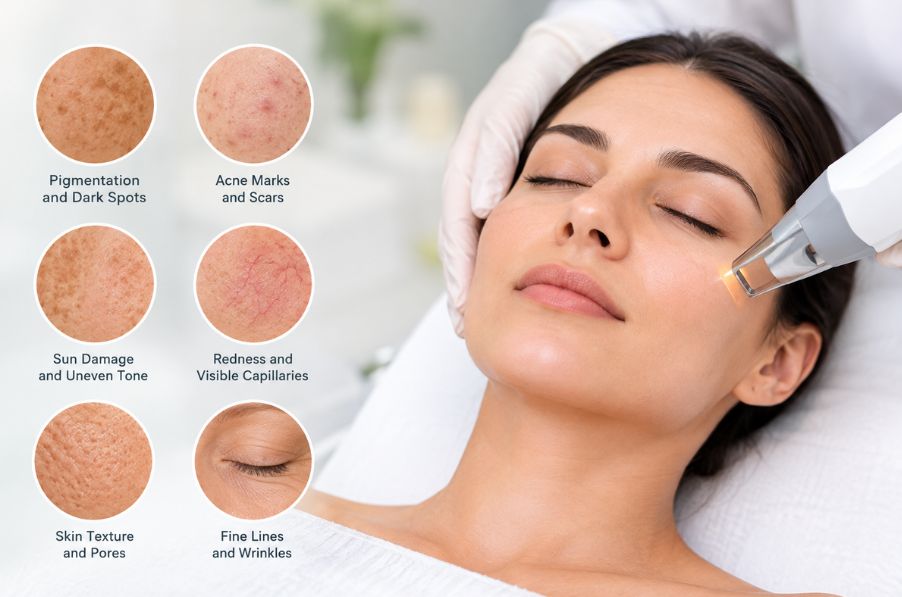
Laser treatments use controlled light energy to target specific areas within the skin.
Different types of lasers are designed to target different things. Some target pigment, while others may be used for visible blood vessels or skin resurfacing.
When treating pigmentation, for example, the laser energy is absorbed by pigment in the targeted area. The treated pigment can then gradually break down and be cleared through the body’s natural processes.
This is why choosing the right technology matters. A treatment that may be suitable for pigmentation will not necessarily be the right choice for redness, scarring or another concern.
A proper skin assessment should therefore come before treatment.
If you are considering professional treatment, you can learn more about our laser skin treatments in Sydney and the technologies available at Sharon MediSkin Clinic.
Pigmentation is one of the most common reasons people ask about laser treatments.
This can include sunspots, age spots and some types of post-inflammatory pigmentation left behind after acne or other skin inflammation.
Certain laser technologies can target excess pigment within the skin. Depending on the treatment used, the targeted areas may initially appear darker before gradually fading as the skin recovers.
Results and the number of treatments needed vary considerably. A small, superficial sunspot is very different from deeper or more complex pigmentation.
Melasma in particular needs careful assessment.
It does not always respond in the same way as ordinary sunspots, and inappropriate treatment can sometimes make pigmentation worse.
This is one reason we do not recommend choosing a laser simply because you have noticed a dark patch on your skin. The type of pigmentation needs to be considered first.
Not every mark left after acne is an acne scar.
Some people are left with flat brown or darker marks after a breakout. This is known as post-inflammatory hyperpigmentation. Others may have redness that remains after the acne itself has settled.
Depending on your skin type and the nature of the marks, certain laser or light-based treatments may be considered as part of a treatment plan.
Actual acne scars are different.
Indented scars, including rolling and boxcar scars, involve changes to the structure of the skin. Treatments designed to improve these scars may focus on resurfacing the skin or encouraging collagen remodelling.
Because acne marks and acne scars are not the same thing, it is important to identify what you are actually treating before deciding on a procedure.
Living in Australia means our skin can be exposed to significant levels of UV radiation over time.
Years of sun exposure may eventually show up as brown spots, uneven pigmentation and changes in the overall appearance of the skin.
Laser treatments may be an option for some forms of visible sun damage, particularly areas of excess pigmentation.
However, treating existing sun damage is only part of the picture.
Daily sun protection remains important after treatment. Laser cannot stop new pigmentation from developing if the skin continues to receive significant UV exposure.
Think of treatment as one part of looking after sun-damaged skin rather than a permanent solution to future sun exposure.
Laser technology is not only used for brown pigmentation.
Some devices use wavelengths designed to target haemoglobin in visible blood vessels. These treatments may be considered for concerns such as facial redness, visible capillaries and certain vascular lesions.
This works differently from treating pigmentation.
If your concern is redness rather than brown spots, the practitioner needs to determine what is causing the redness and whether a vascular laser or another treatment is appropriate.
Persistent facial redness can have different causes, so it should not automatically be treated as a simple cosmetic concern.
Certain laser treatments can also be used for skin resurfacing.
Rather than targeting an individual dark spot or blood vessel, resurfacing treatments create controlled changes within the skin to encourage the natural healing and renewal process.
Depending on the technology used, these treatments may help improve the appearance of concerns such as uneven texture, some acne scars and fine lines.
There are different levels of resurfacing treatment. Some involve relatively little downtime, while more intensive treatments may require a longer recovery period.
More intensive does not automatically mean better.
The right approach depends on your skin, the concern being treated, how much downtime you are comfortable with and the result you are hoping to achieve.
Laser can be useful for many skin concerns, but it cannot address everything.
For example, if facial changes are mainly caused by loss of volume beneath the skin, laser treatment may not address the underlying issue.
Hollow areas, significant facial volume loss and some deeper structural changes require a different assessment and may be better suited to other treatment approaches.
Laser also cannot stop the natural ageing process or prevent future sun damage.
This is why it is better to start with the concern rather than the treatment.
Instead of asking, “Which laser should I have?”, a more useful question is:
“What is causing the change I can see in my skin, and what treatment is appropriate for it?”
Sometimes laser will be the answer. Sometimes it will not.
No.
Skin tone, pigmentation type, medical history, medications, previous treatments and the condition being treated can all affect which treatment is appropriate.
Darker skin tones also require particular care because some laser wavelengths and settings carry a greater risk of unwanted pigment changes.
This is why a standard treatment protocol should not simply be applied to everyone.
The device matters, but so does the person using it.
An experienced practitioner should know how to assess the skin, select appropriate treatment settings and recognise when laser is not the right option.
A consultation should start with your skin rather than the machine.
At Sharon MediSkin Clinic, Sharon first looks at the concern you would like to address and assesses your skin before recommending a treatment.
You can also discuss what has been bothering you, previous treatments you have tried, your expectations and how much downtime you are comfortable with.
If laser is appropriate, you should understand what type of treatment is being recommended, why it has been chosen, what the treatment involves and what kind of recovery to expect.
You should also have realistic information about the likely number of sessions. Some concerns may need only limited treatment, while others require a longer-term approach.
It is easy to focus on the name of a laser when comparing clinics.
But the machine is only one part of treatment.
The practitioner still needs to correctly identify the concern, choose appropriate settings and adjust the treatment according to how your skin responds.
Sharon Kim has more than 26 years of experience in cosmetic and aesthetic treatments and works with clients with a wide range of skin concerns.
Her approach starts with assessing the skin and deciding which treatment is appropriate rather than recommending the same procedure to everyone.
That depends on what you are trying to treat.
Pigmentation, visible sun damage, certain acne marks, vascular concerns and some textural changes may be suitable for laser treatment. Other concerns may respond better to a different approach.
The easiest way to find out is to have your skin properly assessed before deciding on a treatment.
If you are considering laser treatment, Sharon MediSkin Clinic is located on Castlereagh Street in Sydney CBD.
Book a consultation with Sharon to discuss your skin concerns and find out which treatment options may be suitable for you.